
¡Oferta!
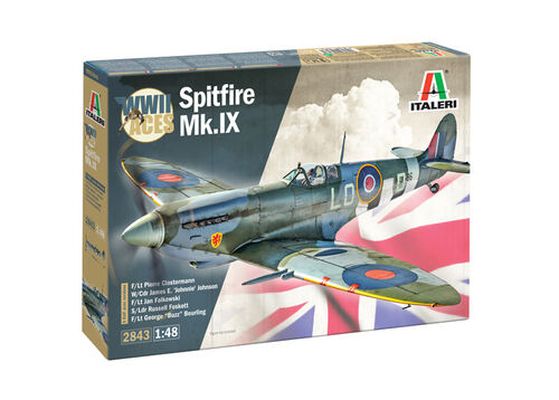
Supermarine Spitfire Mk.IX Axis 1/48 - ITALERI 2843
$ 27.79
Supermarine Spitfire Mk.IX "Axes" Model Kit - RAF "Axes" Version 5 in 1/48 scale - Italeri model.5 RAF "Axes" VERSIONS: F/Lt Pierre Clostermann, W/Cdr James E. Johnson, F/Lt Jan Falkowski, S/Ldr Russell Foskett, F/Lt George BeurlingFIGURE NOT INCLUDEDThe Supermarine Spitfire fighter can undoubtedly be considered one of the most famous aircraft in aviation history and an icon of British aircraft manufacturing. A single-engine, low-wing aircraft equipped with effective offensive armament, its early versions—along with the Hawker Hurricane—formed the backbone of the Royal Air Force’s fighter units during the Battle of Britain against the German Luftwaffe. Victory in the Battle of Britain helped secure great prestige for the Spitfire. It was characterized by its harmonious design, elliptical wing, and powerful Rolls-Royce Merlin engine. During the war, in response to the technological innovations of its adversaries—which led to the development of the formidable Focke-Wulf Fw 190—the Spitfire underwent continuous evolution in its aerodynamic configuration and engines. This led to the production of the Spitfire Mk IX, which, thanks to its performance, was able to compete on equal footing with the most modern German fighters. Piloted by the Royal Air Force’s most famous aces, it achieved a significant number of aerial victories.The Supermarine Spitfire is probably the most famous British fighter of World War II. It was an all-metal aircraft with a low-wing configuration, distinctive elliptical wings, a classic tail, and retractable landing gear. The prototype’s maiden flight took place on March 5, 1936. The Spitfire proved to be the backbone of the RAF’s war effort, continuing to serve effectively after the war and remaining in production for 10 years. The history of the Spitfire began on the drawing board of R.J. Mitchell, Supermarine’s chief designer. The first aircraft were delivered to RAF units in 1938, but by the time the Battle of Britain began in the summer of 1940, there were already 19 squadrons of modern fighters at airfields—along with the slightly older Hurricanes of the Islands, 600 aircraft were defending the skies. As hostilities expanded, the Spitfire saw service wherever the RAF operated—in the Far East, North Africa, and Italy; during the Normandy landings and the fighting in France; and finally during the campaign in Germany in 1945. For many Britons, it became a symbol of victory in World War II. This marvelous aircraft has at least a dozen production variants. The most significant include, among others, the first mass-produced Spitfire Mk.I, powered by a 1,030 CV Rolls-Royce Merlin II engine. It was primarily this aircraft that made such an outstanding contribution to the Battle of Britain. Many versions of this model were developed, including the PR Mk IA (reconnaissance version) and the PR.IG (armed reconnaissance version). Another interesting version was the Spitfire Mk.V, powered by a 1440 CV Rolls-Royce Merlin 45 engine. Later, Merlin 50 engines were also installed. Mass production of this version began in 1941 and was the RAF’s response to the introduction of the Messerschmitt Bf-109F. Another highly successful version is the Spitfire Mk.IX, powered by a Merlin 61 engine with a four-bladed propeller. It was designed to counter the Focke-Wulf Fw-190 and entered production in late 1941. This version underwent several modifications; for example, in 1944 it was equipped with a new gyroscopic sight, a wider rudder, and a different wing configuration. Another major variant is the Spitfire Mk.XIV, equipped with a Rolls-Royce Griffon 61 engine and a five-bladed propeller. Mass production began in October 1943. One of the last series produced was the Mk.21 version. This version featured a Griffon 61 engine, a heavily reinforced airframe and fuselage, and elongated wings, which increased their wing area. Mass production began in March 1945. Technical specifications (Mk.XIV version): length: 9.14 m, wingspan: 11.23 m, height: 3.05 m, maximum speed: 717 km/h, rate of climb: 18.5 m/s, service ceiling: 13,200 m, maximum range: 1,815 km, armament: fixed—4 × 7.7 mm machine guns and 2 × 20 mm Hispano Mk II cannons; external—up to 225 kg of bombs.
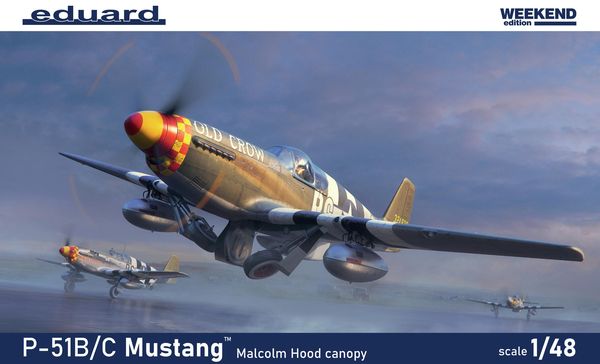 P-51B MALCOLM HOOD 1/48 - EDUARD 84214
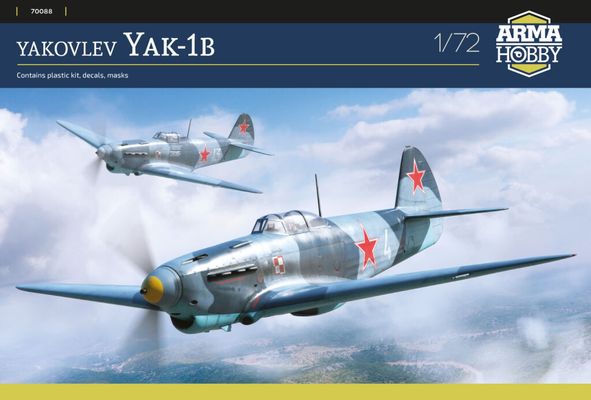 Yak-1b 1/72 - ARMA HOBBY 70088
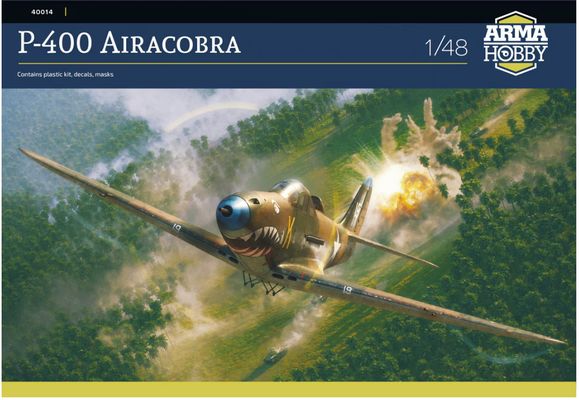 P-400 Airacobra 1/48 - ARMA HOBBY 40014
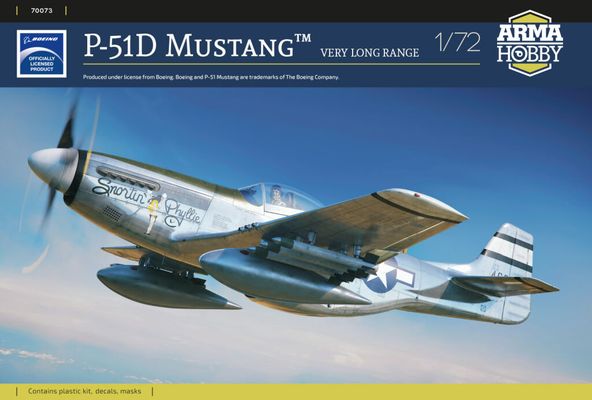 P-51D Mustang 1/72 - ARMA HOBBY 70073